“Do you have a farm”? I’m accosted by a gap-toothed smile of a woman leaning out of a silver Silverado emblazoned with the logo for Nahe Hemp Farm as I leave Day One of the Right to Food Community of Practice (RtF CoP) Summit. I recognise her (she’s had a costume change) as Nicole N’diaye, a hemp/cannabis farmer and professor, who’d earlier spoken on a panel about food apartheid in New York State. I splutter in reply that I don’t have a farm but that I’m in search of a once-an-hour bus. Pointing at my quite-pregnant belly, she tells me to write down her number and call her if I get stuck, before turning back to converse with a farmer and vegan advocate who earlier had given an impassioned speech about the power (and whiteness) of the dairy lobby, and the racist policies of the United States Department of Agriculture (USDA).
The moment turns out to be telling of the contrasts that the next few days will reiterate: the hellish lack of justice in food and land access underpinned by deep-rooted racist and settler-colonial policy, alongside tenderness, care, and what felt like a maternal undercurrent threading together networks of activists who should by right be angry and vengeful but who express their love of the earth through love for other people. Three days later, Leah Penniman of Soul Fire Farm in hey keynote lecture will share statistics on the life expectancy of (largely BIPOC) farmworkers (49 years) compared to 76 for the US population at large. She will retell the history of how slavery was reconstituted, even after abolition, through debt peonage and the Ku Klux Klan, before explaining the ‘butterfly of social change’ as something that invites all of our different skills and temperaments (to resist, to reform, to build and to heal)- and how this butterfly sits upon the shoulders of the many Black pioneers who foregrounded regenerative agriculture (such as George Washington Carver), national school lunches (the Black Panther Party), direct marketing and worker-led agricultural extension (Booker T Whatley). Amidst a past and present of shameful oppression, “hope is the only logical posture to take”, she concluded.
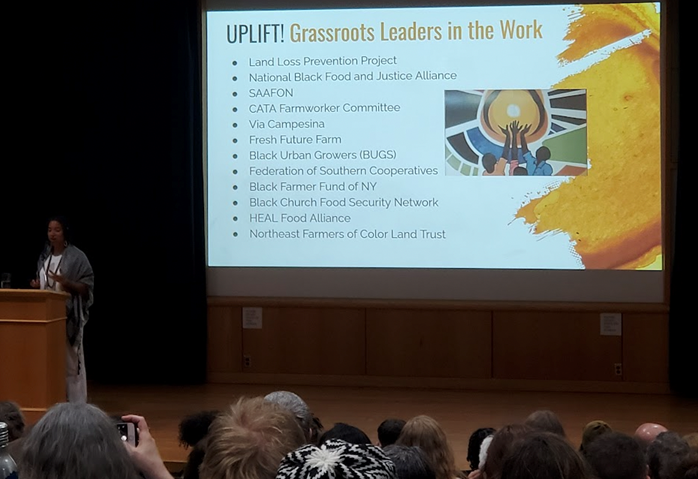
Syracuse in NY State embodies the contradictions that the week surfaced. Built on unceded Onondaga Nation territory (Curtis Waterman of the Onondaga Nation Farm described their ongoing legal battle against Honeywell for its poisoning of waterways in pursuit of salt extraction), it has the US’ second highest child poverty rate (45.8%) and over half of its census tracts are described as ‘food deserts’ (though there was much discussion of why ‘food apartheid’ is a more appropriate term). During a field trip to the Café Sankofa Cooperative we were able to learn a little more about the historical processes and logistical decisions that have carved up communities and resulted in geographical disparities. Scale was a repeated theme as we grappled with the various responsibilities and power of nation-state and international governance actors, place-based grassroots efforts and the role of networks in creating change.
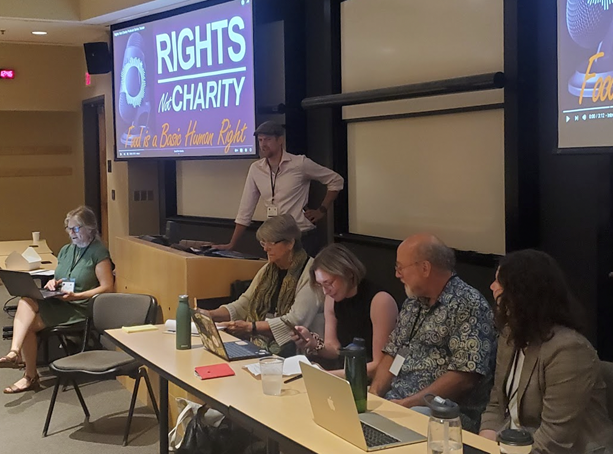
The National Right to Food Community of Practice (Rtf CoP) is a knowledge-sharing network of organizers across the US- from Food Policy Councils to grassroots activists to government officials committed to systems change that would enable the realization of the Right to Food, which means the ability of everyone to eat with dignity and self-determination. For the RtF CoP, this requires challenging the way food is treated as a commodity for the profit of few rather than an entitlement and a commons. Read more about its vision here. The Summit was envisaged as a chance to share strategies and solutions at a time when these are needed more than ever, given climate pressures on food provisioning systems and policies that continue to favour greedy and destructive agribusiness models over the needs of people. The first day of the Summit included diverse panels of activists and stakeholders, including one in which Ashante Reese, Curtis Waterman, Smita Narula, Prakash Kashwan and Craig Hickman helpfully unpacked ‘the Right to Food’: whereas Senator Hickman has (alongside farmer-advocates) got a Right to Food amendment included in the Maine state constitution, Waterman encouraged us to really question the origins of ‘rights’, given how inherent Indigenous rights were quashed by the Pope-sanctioned Doctrine of Discovery that encoded colonisers’ ‘rights’ over the lands: “we don’t need a Right to Food because we ARE the caretakers of the land. We had rights before Columbus arrived”. Navigating these tensions, Prof. Kashman suggested that we need the “right way to think about rights”, as ‘opportunity-opening devices’ that create space for people to hold the powerful to account, rather than as individual entitlements premised on ownership where rights-holders (or givers) may be colonisers. While forms of government are necessary as ways to bind people to collective norms in the face of what he described as ‘ongoing evil’, rights can’t just trickle down but must be nurtured: and here he used the example of Latin American peasant movements that have organised to pressure states to manage things better and be more accountable. Rights, then, are not static but, as democracy should be, ongoing processes of negotiation.
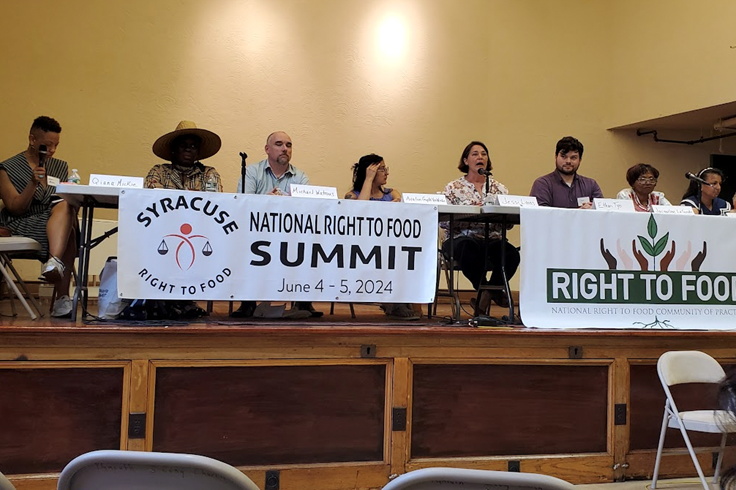
Our discussions were part of that negotiation. City officials were in the room as people with experience of food insecurity, institutional racism and state violence told testimonies and articulated their needs. Fundamentally, we saw evidence of many people determined to improve food systems for themselves and others despite past and ongoing setbacks, from Monu Chhetri who was raised in a Nepali refugee camp and persists in building a farm for her fellow Deaf community despite many traumatic experiences in trying to do so, to Noel Didla who grew up struggling against anti-Dalit oppression to become Board Chair of the Mississippi Food Policy Council. I could say much more, suffice to note that a ‘Community of Practice’ looks something like how the day felt; a holding space for diverse people willing to share and learn in pursuit of some shared visions but without shying away from uncomfortable moments and the ability of less-privileged members to speak truth to power and demand accountability.
The rest of the week was more traditionally academic but the 2024 Agriculture & Human Values/Association for the Study of Food & Society conference included a number of the activists I’d met at the Summit, and it became clear that a number of Food Studies graduates from Syracuse University, under Anne Bellows, have gone on to do both research and non-academic food systems work in ways that tie the university to the wider community. A number of panels I attended included conversations about food system/movement governance: vulnerable lessons learned by scholar-activists engaged in using research to push for change on all kinds of fronts, from the stakeholder panels informing Canadian organic standards and Canada’s Food Policy Advisory Council, to frank reflections on 2023’s Agroecology Summit which brought together activists, scholars, growers and some government officials to strengthen the relationships that might help break through some of the intense structural barriers to realising an agroecological food system. Note ‘relationships’: the theme of how we relate not just to land but to other humans kept repeating itself, with the need not to shy away from the ‘generative conflict’ that comes with confronting heteropatriarchy, capitalism, structural racism and settler colonialism (one Indigenous attendee of the Summit had asked “how can we trust you if you don’t pray before a meeting?”). Hearing academics talk openly about their institutional struggles and their sense of being on a journey rather than feeling that they have all the answers was an invitation to academic humility and honesty about our limitations as well as the need to take our privilege and power seriously. A number of ideas circulated about HOW to do some of this, many drawn from histories of BIPOC liberation and struggle: Learning Circles, ancestor acknowledgment, Community Care Agreements…
The two keynote speakers reiterated these lessons. Leah Penniman spoke of her learning to speak beyond her ‘choir’- even to those who may wish her harm, to build friendships with Indigenous communities (her farm was able to share blue corn seed when their neighbours had seen a crop failure) and to embrace practices such as song and dance that might not sit comfortably with her ‘left-brain’ preferences but that might enable others to connect with her farm differently. Michael Fakhri, law professor and UN Special Rapporteur on the Right to Food, used his keynote to describe law as both an opportunity and a limit: pieces of law can be used to channel resources, pressure governing bodies to act differently, and to clarify the stakes where powerful entities are failing to merit the power they hold. Narratives and solidarity networks matter in defining where a legal loss might actually result in a longer-term win for a movement.
Fakhri has been writing about small-scale fisher rights, which has been helpful for my own research focus, but a major part of his work of late has been advocacy for Gaza. He spent the latter part of his lecture explaining the way state-sanctioned starvation operates as a component of genocide, though Gaza represents a speeding-up and intensification of the more mundane ways in which state neglect enables hunger to prevail even in the richest countries in a process of ‘slow violence’. Under settler-colonialism, the dispossession of peoples from their ancestral links to land, sea and knowledge has long been part of imperialism and the use of hunger as a tool of political control. The ongoing poisoning of olive orchards, the destruction of Gaza’s fishing fleet and the denial of adequate water as well as food aid have been strangling Palestine’s food security for decades, and we are witnessing an intensification of this process in ways that will determine (and likely damage) the legitimacy of the states that are complicit, for years to come.
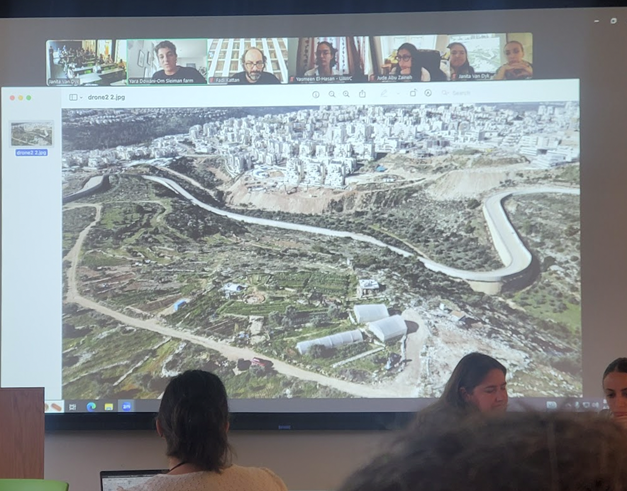
Another panel convened Palestinian chefs, union organisers and farmers based in the West Bank via Zoom in ways that brought Fakhri’s observations into fleshy reality. Author and chef Fadi Kattan described the ecocide underway as a continuation of long-term processes of appropriation that are not a Palestinian exception but part of we might call ‘food regimes’- the ideological and material domination of particular ways of controlling foodways that link food insecurity in Syracuse to the US’ sending of tides of weapons alongside trickles of food aid as though the latter somehow resolves the former. Yet Kattan and his co-panellists also conveyed the resilience of Palestinians through their culinary heritage and practices even under brutal conditions: how occupation led farmers to develop their own composting and seed-saving habits in the knowledge that they cannot rely on outside inputs. “Support our steadfastness”, urged Yara of Om Sleiman Farm. Ongoing student resistance was frequently mentioned as a source of hope; Syracuse University had already agreed to divest from fossil fuels, so to divest from (fossil-costly) arms dealing was not a big leap, as one student organizer told us.
I was able to share some of my preliminary research about fishing governance in the NWT (to which we’ve been applying agroecology as an alternative framework to mainstream ‘conservation’) in a fantastic panel aimed at bringing fishing into food studies curricula. Paul Greenberg (author of Four Fish) spoke of the funding he’s received to give an hour-long introductory lecture to food studies courses (get in touch if you run a fishless course!). L. Sasha Gora gave a harrowing account of swimming among caged tuna in researching for a book about the globalisation of the fish, what she described as the “tragedy of the commodity”, and Kristin Lowitt shared research with fishing communities about how a Basic Income Guarantee could support fishing livelihoods. I joined a roundtable with fellow organizers from a network that I’ve been organizing with virtually since lockdown, and we had a great session on scholar-activism for moving from food charity towards rights, where I was able to share some of my podcasting work. Finally, a moving session by some of the convenors of 2023’s Agroecology Summit shared some of the lessons learned, many of which echoed the themes of the first days in Syracuse- researchers grappling with their positionality, ancestry and institutional power. The team showed a film with two participants in the Summit that for me voiced the deep and paradigmatical shifts that would mark a true agroecology as co-creation in interdependence.